Camera Fundamentals
The Exact Beginner Camera Settings for Sharp Landscape Photos
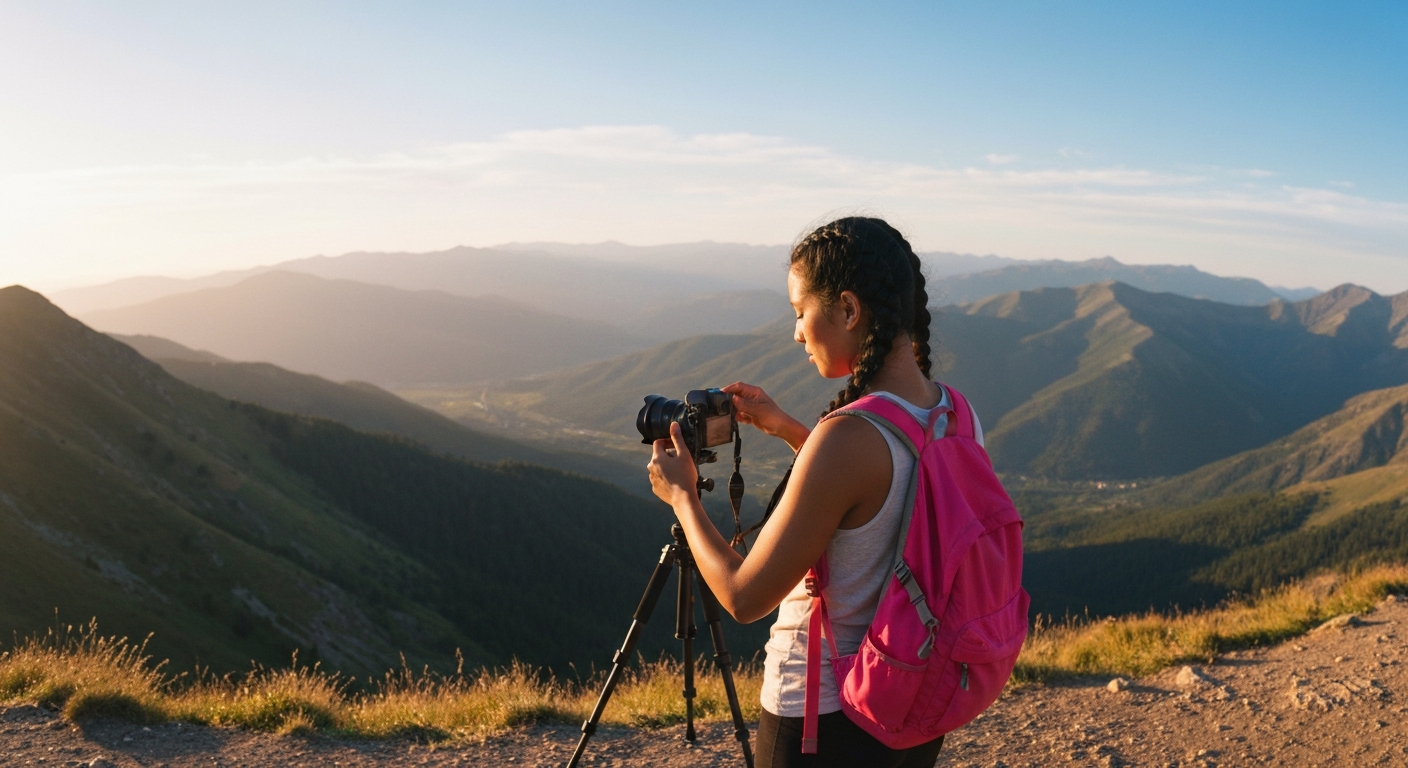
Landscape photography requires a completely different mindset than portrait photography. Instead of trying to blur the background, your goal is usually to get everything—from the flowers at your feet to the mountains miles away—in crisp, stunning focus.
Many beginners think the solution is simply to dial their aperture to the highest possible number, like f/22. But when they do, their photos often look surprisingly soft and muddy. Here are the exact settings you need for razor-sharp landscapes.
The "Sweet Spot" of Your Lens
Every lens has a "sweet spot"—an aperture where it performs at its absolute sharpest. It is rarely at the extreme ends (not f/1.8 and not f/22). For most lenses, the sweet spot lies somewhere between f/8 and f/11.
Shooting at f/8 gives you a deep enough depth of field to keep the foreground and background in focus, while avoiding a physics problem called lens diffraction. Diffraction happens at extremely tight apertures (like f/22), where the light waves get squeezed so tightly that they scatter, causing your entire image to lose sharpness.
ISO 100 is Non-Negotiable
For the cleanest, sharpest landscape images with the most dynamic range (detail in both the bright skies and dark shadows), you must keep your ISO at its base level—usually ISO 100.
Raising your ISO introduces digital noise (grain) that destroys the fine details in leaves, rocks, and textures. If there isn't enough light to shoot at f/8 and ISO 100, you shouldn't raise your ISO; you should lower your shutter speed.
The Tripod: Your Secret Weapon
Because you are shooting at f/8 and ISO 100, your shutter speed will often drop dangerously low, especially during the beautiful light of golden hour. This is where a sturdy tripod becomes your best friend.
With a tripod, your shutter speed can be 1/10th of a second, 1 second, or even 30 seconds, and as long as the wind isn't blowing the trees, your landscape will be perfectly sharp.
The Assignment
Find a beautiful scene. Put your camera on a tripod. Set your ISO to 100, your aperture to f/8, and let your camera decide the shutter speed (Aperture Priority mode). Use a 2-second timer so your finger doesn't shake the camera when you press the button. Review the image and zoom in—you'll be amazed at the detail.
Ready to stop guessing and start creating? In my best beginner photography course, Camera Zero to Hero, I teach you the exact frameworks to capture stunning landscapes, portraits, and more. Enroll today and transform your photography.